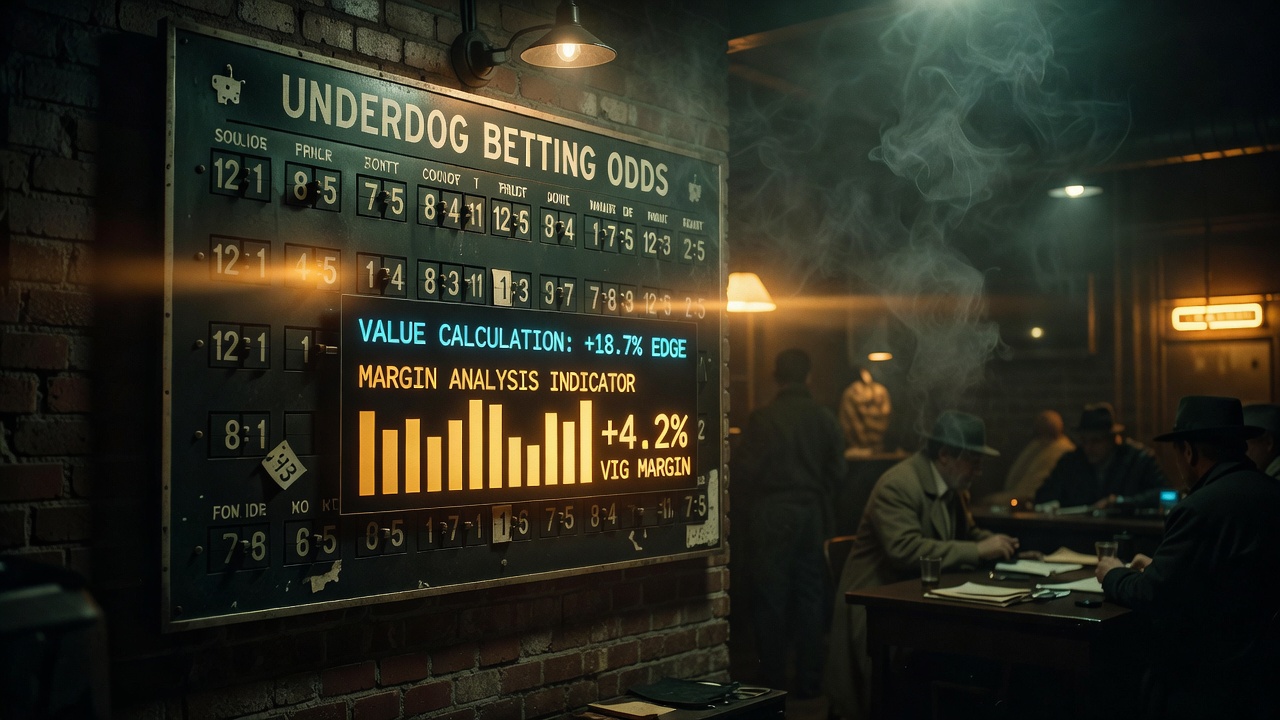
Underdogs are underdog because the public leans the other way. The public wants the favorite. The favorite feels safe. But underdog lines are often where the real edge is because they are neglected.
The details of execution separate success from failure.
Let me break the economics. A sportsbook has two incentives. First, balance action so the public money does not expose them to catastrophic loss. Second, maximize the juice they take from the losing side. These incentives sometimes align, sometimes conflict. Underdog lines are where the conflict shows up.
If the public is 70-30 on the favorite, the sportsbook adjusts the line to attract money to the underdog. But the sportsbook does not adjust the line to be fair. The sportsbook adjusts it to be just attractive enough to balance action while still maintaining edge. This means the underdog line is often better than it should be.
The formula is simple. Find a game where public opinion is heavily skewed to the favorite. The more skewed, the more the sportsbook has had to move the underdog line to balance action. The more moved, the more value the underdog might have.
The catch is that public opinion is sometimes right. A heavily favored team is often heavily favored for good reasons. They are better. They have better players. They have better coaching. The fact that the public likes them does not mean they are wrong.
But sometimes the public is wrong. Sometimes a team that is heavily disrespected is actually pretty good. Sometimes a team playing their best game is facing a team coming off a loss. Sometimes the injury situation creates value on the underdog side that the market has not fully priced in.
The mental discipline required is: do not fade the public just because they are the public. Fade the public when your independent analysis suggests they are wrong and the line has moved far enough in the underdog's favor to reflect fair value.
I watched a player in 2019 make a season of underdog bets. Every bet was on the underdog at plus money or better. The bet selection was rigorous. The player was looking for spots where underdog teams had good matchups and where the line had moved far enough to be fair.
The player won at 55 percent. That does not sound impressive. But at minus 110 juice, you need to win 52.4 percent to break even. Winning 55 percent is profit. The player made money all season by finding value in lines that the casual public thought were bad.
The key insight is that the public is not trying to find value. The public is trying to pick winners. These are different things. A picker wants to know who is going to win. A bettor wants to know if the line offers value relative to the true probability. These are only the same thing when the line is fair, which it almost never is.
Underdog value is real. It is just not obvious.
The deeper analysis of this topic reveals that players often overlook the foundational principles. When you understand the mechanics and the motivations behind the game design, you begin to see patterns that were previously invisible. This is where real advantage comes from, not from luck or superstition, but from careful observation and mathematical reasoning applied over time. Every decision matters. Every detail counts. The players who take the time to understand these nuances are the ones who make better choices at critical moments.