The craps table is a machine for organizing chaos. Thirty-six inches of felt printed with symbols, numbers, and betting zones. It looks intimidating because it is designed to be. That complexity is not a bug. It's the feature that makes craps the highest-energy game on the floor.
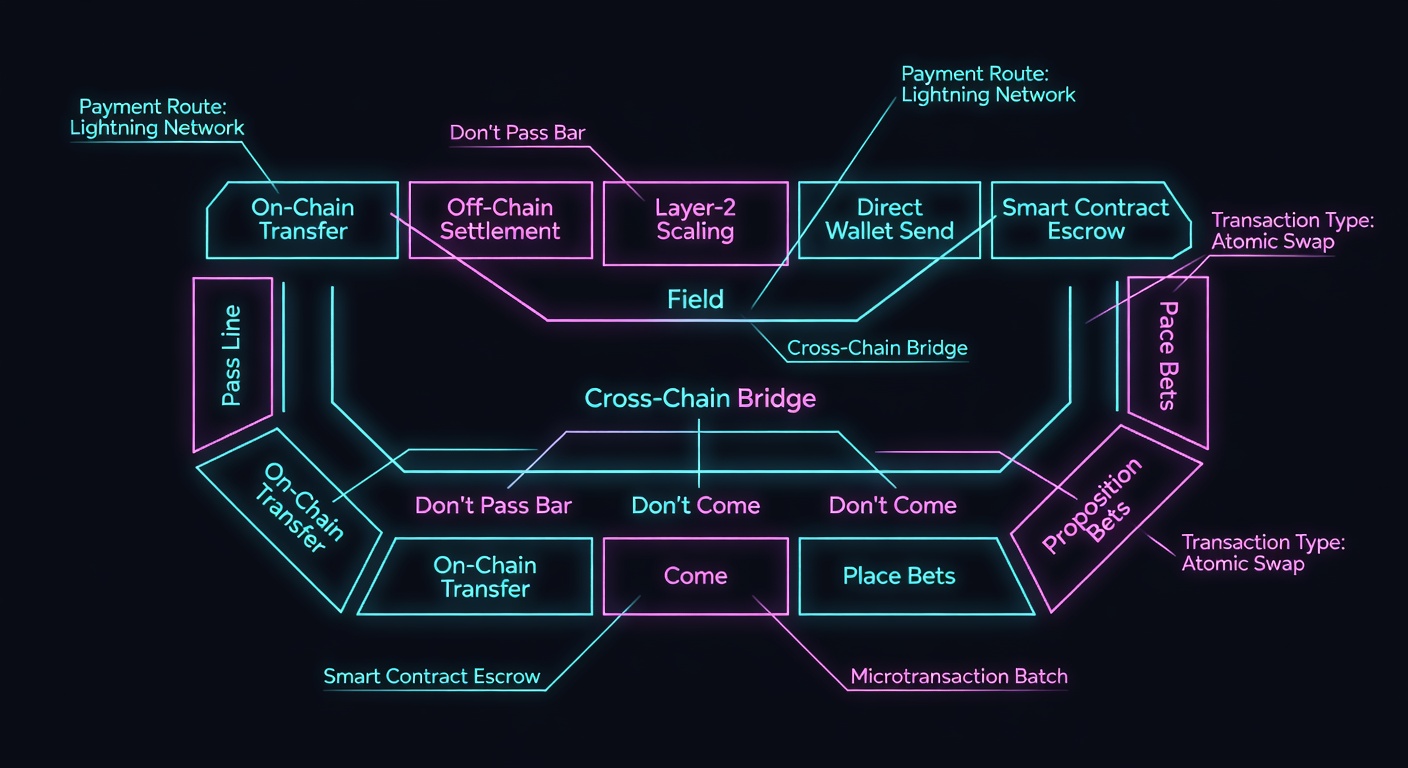
Walk up to a live craps table at DraftKings' sportsbook or any physical casino and you see the basic split. The center of the table belongs to the house. The perimeter belongs to the players. The layout is symmetrical left and right. One stickman in the middle. Two dealers on opposite sides. The players stand around the outside.
The Betting Zones
The Pass Line runs along the edge closest to the players. This is the baseline bet. You place chips on it before the come-out roll. If the shooter rolls a 7 or 11, you win immediately. If they roll 2, 3, or 12, you lose immediately. Any other number becomes "the point." The dealer marks it. Now you win if the shooter rolls that number again before rolling a 7.
The Don't Pass Line sits opposite, running along the far edge. It's the inverse of the Pass Line. You win on 2 or 3. You lose on 7 or 11. You push (neither win nor lose) on 12. The risk and reward flip.
The Come and Don't Come boxes sit in the middle section. They work exactly like Pass and Don't Pass, except you place them after the point is established. This is where the action accelerates. Multiple bets can be working simultaneously. Multiple points can be in play.
The Field
The Field is a large rectangular box in the center. It covers twelve numbers: 2, 3, 4, 5, 6, 8, 9, 10, 11, 12. One roll covers most of these outcomes. The payoff is low (even money on most) but the probability is tempting. This is the bet that makes craps addictive for casual players.
Around the edges sit the place bets: 4, 5, 6, 8, 9, 10. You can place a bet on any of these numbers. If it rolls before a 7, you win at predetermined odds. The 6 and 8 pay 7 to 6. The 5 and 9 pay 7 to 5. The 4 and 10 pay 9 to 5. The odds are baked into the position on the felt.
The Hard Ways
In the center of the table, off to one side, sit the Hard Way bets. These are the bets that make serious players shake their heads. You bet that a number will roll as a double (2-2 for four, 3-3 for six, 4-4 for eight, 5-5 for ten) before rolling any other way. The payoff is high. The probability is low. Pragmatic Play's live tables show these constantly, watched by the streamers, never seriously played by anyone with a plan.
The Proposition Bets
In the very center, in front of the stickman, sit the proposition bets. These are the high-variance, high-payoff bets. Snake Eyes (rolling two ones). Yo (rolling eleven). Boxcars (rolling two sixes). Betting any seven on the next roll. These bets have some of the worst odds on the table. House edges north of 10 percent. They exist to separate recreational players from their money fast.
You look at the layout and see chaos. What you're really seeing is a system designed to answer a single question: what will come next? Every zone on that table is a different way of answering it. Every player at the table is betting according to their own theory. The beauty of craps is that dozens of different theories can run simultaneously, each with its own odds, its own payout structure, its own possibility.
The shooter throws. The layout absorbs the result. Chips move. Money transfers. The next roll is coming. That's the whole game.