Jon Heywood was 26 years old. He was a soldier stationed in Cyprus. He was playing online slots in what appears to have been a bored moment. He bet 25 pounds. The Mega Moolah progressive jackpot was at its peak: over 17 million pounds accumulated. The next spin could reset it. His spin hit it.
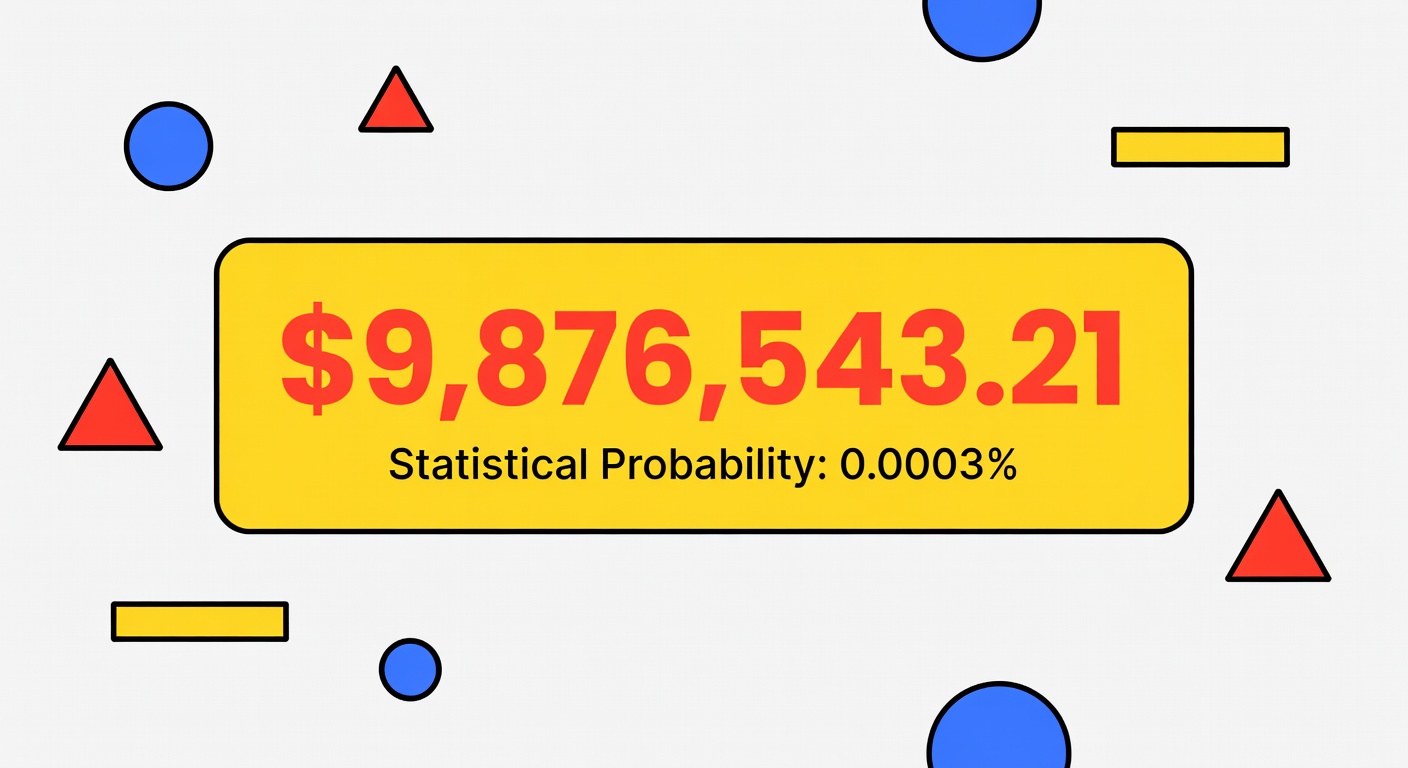
The payout was 17,879,645 British pounds. After taxes, he took home approximately 12 million pounds. This was life-changing. He bought a house. He bought a car. He spent money on things that soldiers on a salary cannot normally afford.
Why is this relevant to understanding gambling? Because the win is statistically possible but practically impossible for any individual. The Mega Moolah game has a fixed payout percentage (called RTP, or Return to Player). For Mega Moolah, it is roughly 88-92 percent depending on the specific version. This means that for every 100 pounds wagered by all players combined, the game returns 88-92 pounds. The house keeps 8-12 percent.
But Mega Moolah has a progressive jackpot. A portion of every bet feeds the jackpot. When the jackpot is hit, it resets to a base amount. The timing of when you bet relative to when the jackpot is hit is entirely random from your perspective. You cannot predict it.
The Mathematics of the Win
Jon Heywood's odds of hitting that specific jackpot on that specific spin were approximately 1 in 50 million. This is not a guess. Pragmatic Play (the developer of Mega Moolah) publishes the odds. If 50 million spins occurred, statistically one would hit the mega jackpot.
How many people were playing Mega Moolah globally in November 2015? Probably millions. How many spins occurred per day? Possibly hundreds of millions. So statistically, a mega jackpot hit every few days was expected. That it landed on Jon Heywood's account was luck combined with the mathematics of large numbers.
But here is the important part: Jon Heywood's win was not offset by his previous losses and future losses in the way that a regular player's losing sessions are. He won the lottery. This is not part of the normal gambling experience. The normal gambling experience is losing 8-12 percent of the money you wager over time.
Jon Heywood's expected loss over his lifetime of Mega Moolah play would be approximately 12 percent of his total wagered. If he wagered 5,000 pounds total (a rough guess), his expected loss would be 600 pounds. Instead, he won 25 pounds and got a 17-million-pound payout.
This win became famous because it was so rare and so large. It got media coverage. It inspired people. It made Mega Moolah the most famous online slot game in the world. Every day, new players saw the Jon Heywood story and thought, "That could be me."
The Impact
The impact of the story is subtle but important. It changed how people perceived Mega Moolah risk. Before the story, Mega Moolah was a medium-volatility slot with a progressive jackpot. After the story, Mega Moolah was the game where that British soldier won 17 million pounds. People wanted to be that soldier.
Pragmatic Play did not explicitly use the story in advertising, but they did not need to. The story was out there. Players knew about it. Players pursued it. The Mega Moolah game became the second-most-played slots game in online casinos (after NetEnt's Starburst, another famous progressive).
This illustrates a principle: famous wins drive engagement. A casino that has a famous winner gets more play than a casino without famous winners. This is true even though the odds of winning are exactly the same. The narrative shapes behavior.
What happened to Jon Heywood after the win? This is less commonly discussed. He bought a house in Cheshire. He bought a Range Rover. He bought a Porsche. Some media reported that he planned to stay in the military and use the money for the future. Other reports suggested he would leave the military and travel.
I do not have recent information on what he is doing now. But the point stands: his win was exceptional. It happens once every several years in an industry. Yet it sells slots games. The promise of the exceptional outcome, even at odds of 1 in 50 million, drives behavior.
From a card counter's perspective (my perspective), the lesson is simple: exceptional outcomes are not strategy. They are noise. The strategy is to understand the long-term expected value of what you are doing. For Mega Moolah players, the long-term expected value is a 12 percent loss. The possibility of a 17-million-pound win does not change this. It only makes the journey of losing 12 percent feel occasionally like you might be getting lucky.