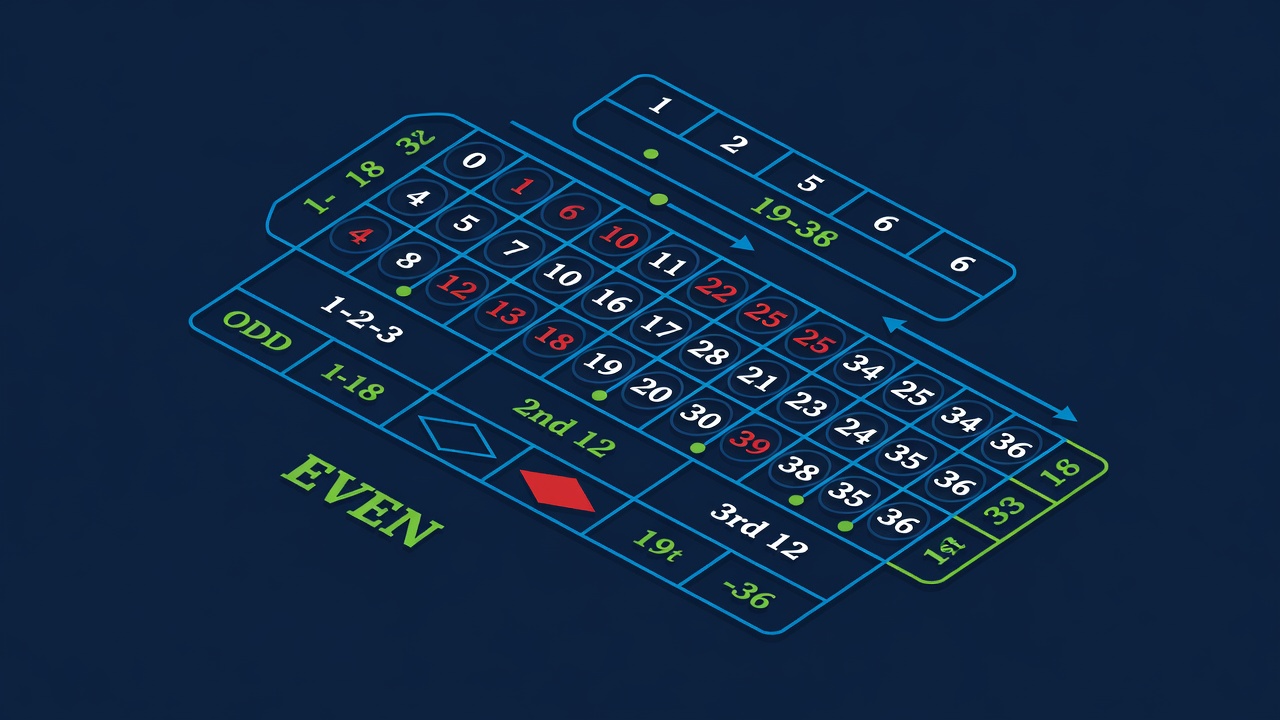
Right then, listen. The racetrack on a roulette layout is the horseshoe-shaped area you see on the cloth above the numbered pockets. It's called that because it looks like a racetrack if you use your imagination and you're three drinks in. That's about the only fancy name for it. It's just a place to put your chips and make a bet without using the grid of numbers. Old London bookmakers used it. We still do.
The track allows what we call called bets. You point at the track and you say a name. The croupier knows what you mean. Voisins du Zero covers seventeen numbers: 22, 18, 29, 7, 28, 12, 35, 3, 26, 0, 32, 15, 19, 4, 21, 2, 25. That's the numbers nearest to zero on a European wheel. If any of those come in, you win. The payout depends on how much you wagered and how many bets it required. That's the maths of it.
Tiers du Cylindre covers the opposite side of the wheel. 12 numbers: 27, 13, 36, 11, 30, 8, 23, 10, 5, 24, 16, 33. It's the third of the wheel opposite from zero. Orphelins covers the gaps: 17, 34, 6, 1, 20, 14, 31, 9. You've got your wheel divided into sections, and each section has a name and a bet.
Why would you use the racetrack instead of betting individual numbers? Speed and nostalgia, mainly. If you know the sections by name, you can place the bet in seconds. You don't have to count out individual chips on individual numbers. You just say the name. The house doesn't mind because the odds don't change. It's the same bet mathematically whether you arrive at it by covering seventeen separate numbers or by making one racetrack call.
The racetrack persists because it is useful in live play, especially in Europe and Asia. Online roulette doesn't need it because you can just click numbers. But at a table with a croupier, speed matters. Tourists don't use the racetrack. They don't know it exists. But professionals do. A regular at a European casino knows the racetrack intimately. It's the difference between looking like you know what you're doing and looking like you just arrived on a tour bus.
The real advantage of the racetrack is that it forces you to think in sections rather than individual numbers. If you're betting big on voisins, you're betting on a geographical cluster on the wheel, not on a theory that number seventeen is lucky. This is, frankly, a better way to think about roulette. The wheel has structure. The racetrack articulates that structure. Using it reminds you that roulette is a game of sections and clusters, not individual mystical numbers.
Key Considerations
The fundamental principle behind this topic involves understanding several interconnected factors. Each plays a distinct role in the overall picture. First, you must grasp the mechanism. Second, you need to recognize how it applies to your specific situation. Third, you should understand the exceptions and edge cases.
- The first consideration involves mechanics: how the system actually works
- The second involves application: how to apply knowledge to your situation
- The third involves exceptions: when normal rules do not apply
Different perspectives exist on this topic. Some emphasize one aspect more than others. The most complete understanding comes from considering multiple viewpoints and recognizing what each reveals about the underlying truth.
The practical wisdom here is that understanding requires both mechanics and experience. You can read about something theoretically, but real understanding comes from engagement with it.
Therefore, when you encounter this topic in practice, remember to think systematically about what is happening and why. The details matter. The structure matters. The exceptions matter. Approach it with the rigor it deserves.