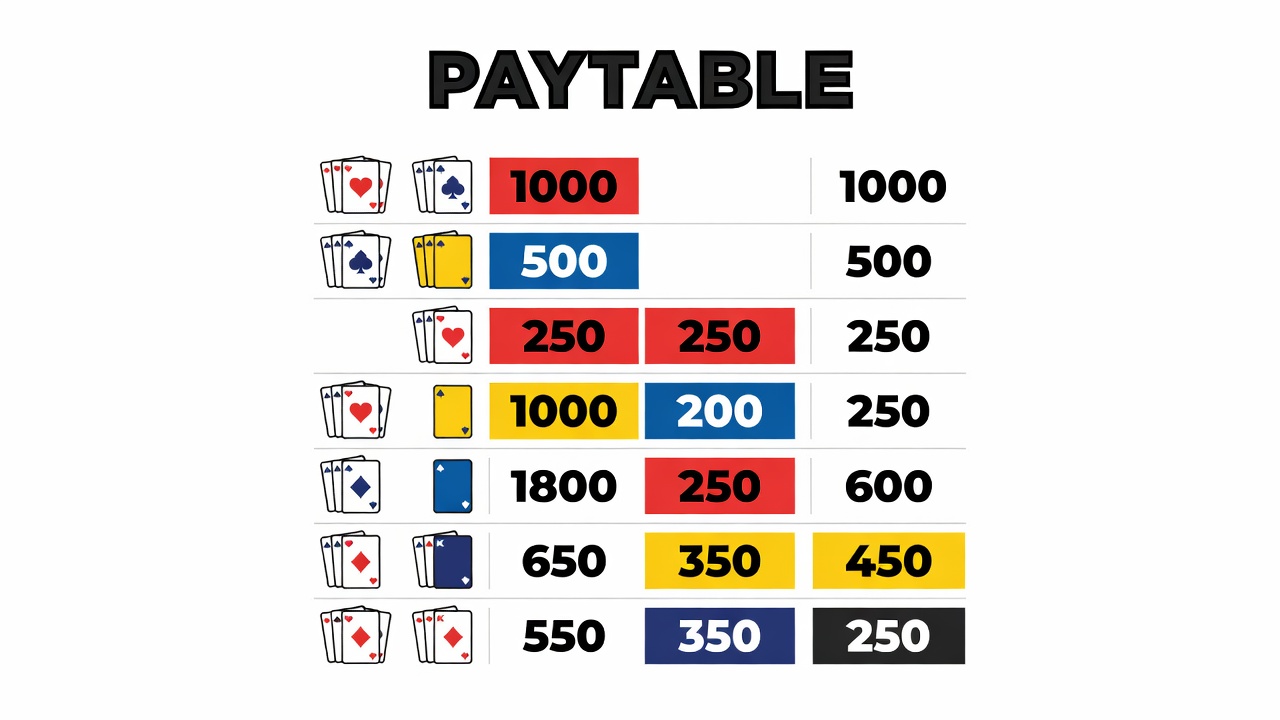
A paytable is a legal document printed on or integrated into every table game that specifies what each winning hand, spin, or outcome pays. Accordingly, any player wishing to make informed decisions on a gaming floor must understand how to extract and interpret the information it contains. A paytable is not guidance or suggestion; it is the binding statement of payouts for that particular game instance. Understanding it requires understanding three distinct categories of information: the base payouts for standard outcomes, the house edge derived from those payouts, and any special or promotional payouts that apply during your session.
The base structure of a paytable is systematic. For example, at a typical three-card poker table, the game offers two principal wagers: a "Ante" bet and a "Play" bet. The paytable will specify that a player hand ranking from a pair of sixes upward qualifies to beat a dealer qualifying hand, that pairs pay 1 to 1 on the Ante bet, three of a kind pays 4 to 1, a straight pays 6 to 1, and so on. These multipliers are fixed. They do not vary by time of day, by whether you have won three hands in a row, or by any other contextual factor.
The relationship between payouts and house edge is strictly mathematical. A paytable that pays 3 to 1 for a winning hand that occurs with frequency 1 in 4 will, across infinite hands, net the house a profit equal to the difference between what was paid out and what was collected. Specifically, if you make four bets of one unit each, win once at 3 to 1, you collect four units (your bet plus the three-unit payout). You have lost a total of three units across four wagers. The house edge is 25 percent. This calculation extends to every entry on the paytable.
In practice, the casino publishes the house edge for each game, usually printed on the paytable itself or in a rule sheet available by request. A compliance officer will describe the house edge as the expected loss per unit wagered across an infinitely large sample. On a game with a house edge of 2.7 percent, if you wager one thousand units over an evening, the expected outcome is a loss of 27 units. This is not a prediction for any single evening; it is a mathematical certainty across sufficiently large samples.
Special or promotional payouts appear on the paytable as separate lines. For example, a blackjack table might specify that under standard rules, a natural blackjack pays 3 to 2. Under a temporary promotion or during a specific shift, the paytable might be altered to pay 6 to 5 instead. This change materially worsens the player's position. A three-to-two natural on a two-thousand-hand sample at a full table translates into a significantly different profit or loss versus a six-to-five structure. Any player reading the paytable will notice this immediately.
Reading a paytable is therefore not a skill; it is a necessity. The paytable removes ambiguity. What it pays, what it costs, and what your mathematical expectation is across large samples are all stated explicitly. The strategic question for any player is whether those payouts, given the frequency of outcomes, represent a wager they are willing to make.
Key Considerations
The fundamental principle behind this topic involves understanding several interconnected factors. Each plays a distinct role in the overall picture. First, you must grasp the mechanism. Second, you need to recognize how it applies to your specific situation. Third, you should understand the exceptions and edge cases.
- The first consideration involves mechanics: how the system actually works
- The second involves application: how to apply knowledge to your situation
- The third involves exceptions: when normal rules do not apply
Different perspectives exist on this topic. Some emphasize one aspect more than others. The most complete understanding comes from considering multiple viewpoints and recognizing what each reveals about the underlying truth.
The practical wisdom here is that understanding requires both mechanics and experience. You can read about something theoretically, but real understanding comes from engagement with it.
Therefore, when you encounter this topic in practice, remember to think systematically about what is happening and why. The details matter. The structure matters. The exceptions matter. Approach it with the rigor it deserves.