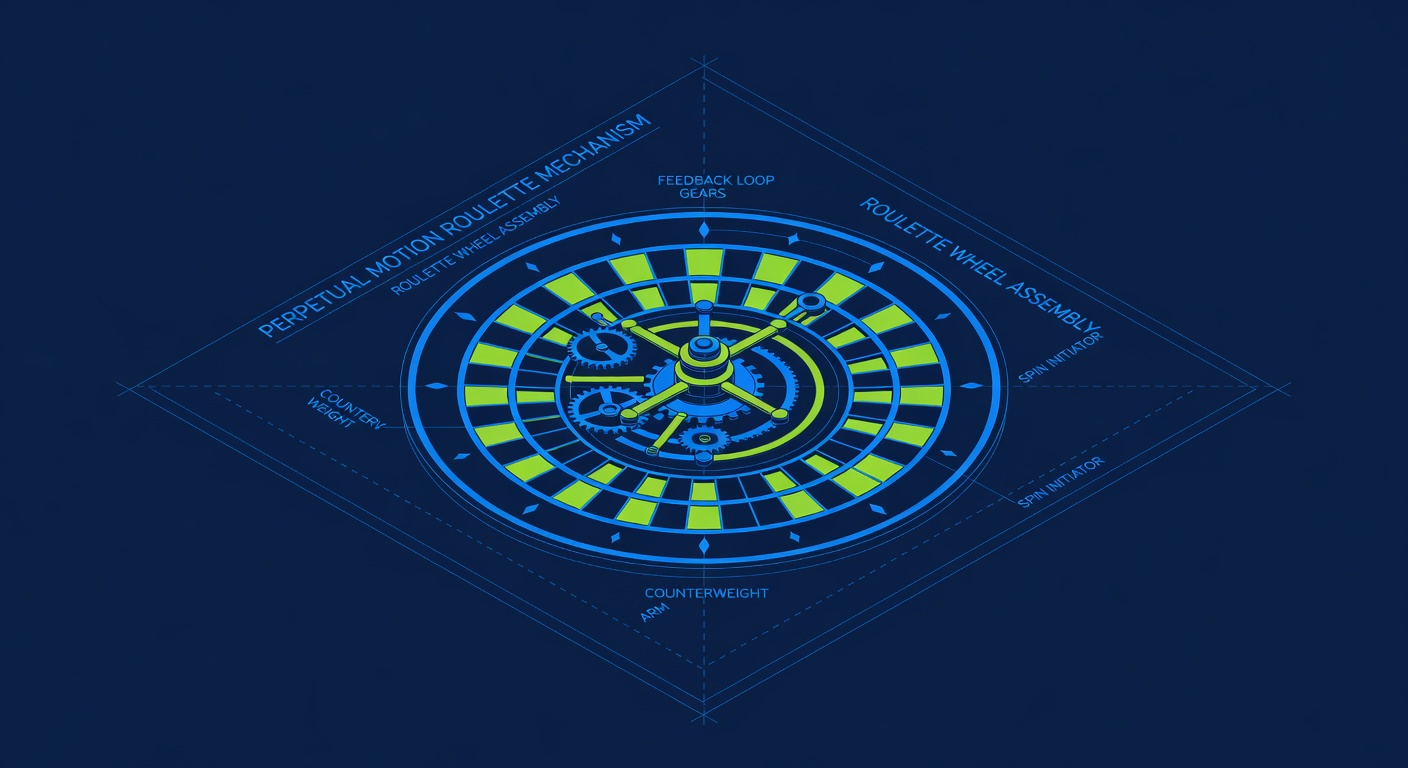
Blaise Pascal was trying to build something impossible. In 1655, he was tinkering with a wheel, attempting to create a perpetual motion machine. He failed (you can't create perpetual motion; thermodynamics won't allow it). But he built a wheel that spun really well.
Someone saw that wheel. Maybe Pascal himself. Whoever it was, they realized it could be used to settle bets. You spin the wheel. The wheel slows. A ball rolls and comes to rest on a number. Randomness, applied mechanically. A perfect instrument for gambling.
Roulette as a game emerged in 18th century France. The first wheels had 36 numbers: 1 through 36. No zero. Casinos noticed they were losing money on this wheel (since the player and the bank had nearly equal odds). In 1842, a wheel with a zero was introduced. The zero gave the house an edge.
Spread to Italy. Spread to Germany. Spread to America. By the 1800s, roulette was in every major casino. The American version added a double zero (00 and 0). This increased the house edge even further.
The Mechanics
Modern roulette wheels have either 37 numbers (European: 1-36 plus 0) or 38 numbers (American: 1-36 plus 0 and 00). The wheel is spun. A ball is released in the opposite direction. As the wheel slows, the ball bounces and settles into one of the numbered pockets.
The outcome is ostensibly random. In practice, there are small biases (a wheel can be slightly unbalanced) and methods (a skilled dealer can subtly influence where the ball lands). Casinos take precautions. They rotate wheels. They inspect them. They use new balls. Modern casinos work hard to keep roulette fair.
Betting happens before the ball settles. You place chips on the felt. You can bet on a single number, a group of numbers, a color (red or black), odd or even, high or low. The payoff depends on the probability. Single number bets pay 35 to 1. Red or black pays 1 to 1.
The House Edge
Roulette's house edge is straightforward math. On a European wheel with 37 numbers, if you bet $1 on a single number and win, you get paid $35. Your actual odds of winning are 1 in 37. So over 37 spins, you'd lose $36 and win $35. Net loss of $1. House edge is about 2.7 percent.
On an American wheel with 38 numbers, the house edge is about 5.26 percent. This is much worse. If you must choose a wheel, choose European.
Red or black bets have the same house edge (2.7 percent on European, 5.26 percent on American) even though they seem like they should be 50/50. The zero(s) account for the difference.
Why People Play It
Roulette is simple. You don't need skill. You don't need to read opponents. You don't need to remember anything. You just need to choose a number and hope. The appeal is partly the simplicity and partly the psychology: with enough money and enough time, you could theoretically get lucky and win.
In reality, roulette is one of the worse bets in the casino. Blackjack with basic strategy has a house edge around 0.5 percent. Craps with optimal bets has an edge around 1.4 percent. Roulette has an edge over 2.7 percent. For every $100 wagered on roulette, you expect to lose about $2.70 (on European wheels).
But people play it anyway. The appeal is not rational. It is the appeal of simplicity and the hope of a lucky bounce.