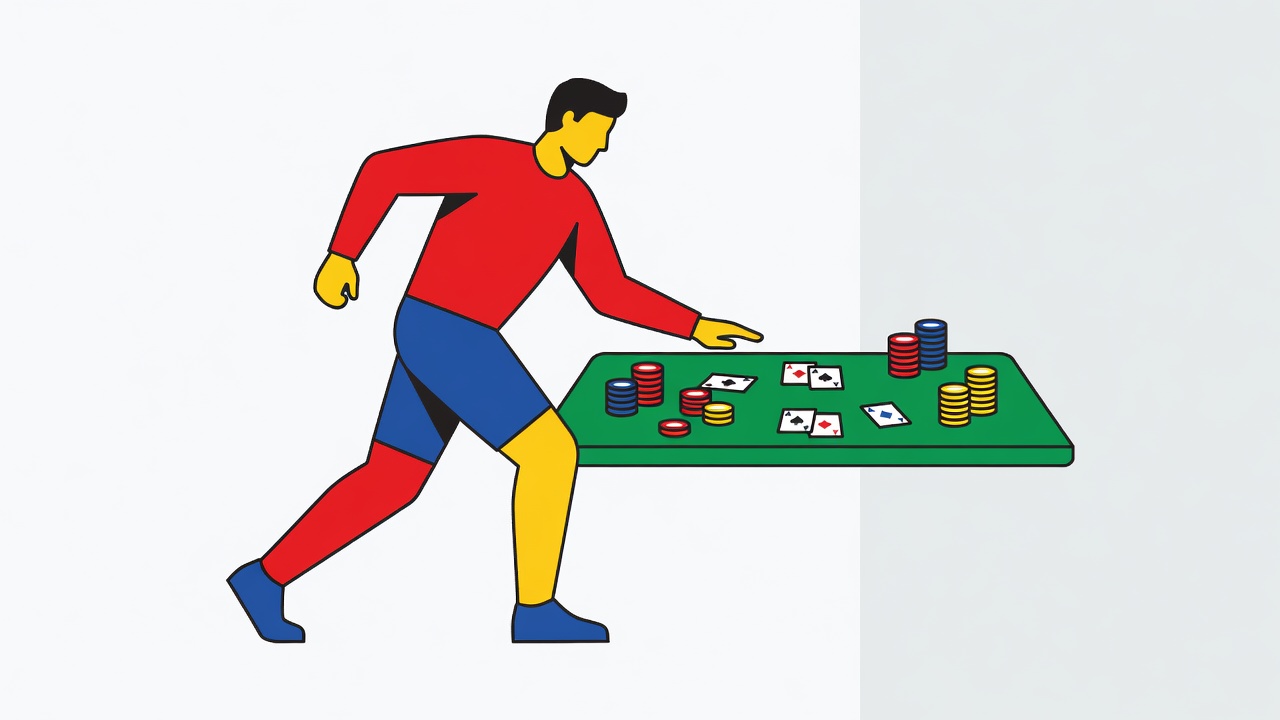
Erik Seidel was a ballroom dancer before he was a poker player. This is true in the literal sense and in the metaphorical one. He moved through poker the way he had moved through dance: precisely, rhythmically, in conversation with the music only he could hear. The poker world has consumed his story, parsed it, and made it fit the narrative of the mathematical savant who decodes the game. That is true. But the dancing part matters.
Seidel grew up in Chicago, learned to dance young, and danced seriously into his twenties. By the 1980s, he was professional but not wealthy. Poker was an alternative. He was good at card games generally, good at pattern recognition, good at discipline. He entered tournaments when the prize pools were smaller and the fields were weaker. He began winning.
What separated Seidel from other strong mathematical players was something harder to codify. He had rhythm. He had timing. He understood table flow and player cycles the way a dancer understands tempo and phrasing. When other players were tight or loose, when they were tired or sharp, when they were vulnerable, Seidel seemed to sense it. Not through magical intuition, but through the kind of embedded knowledge that comes from years of studying patterns. He could adjust his game in real time, not with sudden dramatic shifts but with small, calibrated movements.
His results speak for themselves. He won his first World Series of Poker bracelet in 1988. He won a second in 1989. He was a member of the syndicate that won the 1992 World Series championship. Over three decades, he accumulated seventeen bracelets, placing him among the winningest tournament players in WSOP history. His total earnings from tournament poker exceed eighteen million dollars. But the number that might matter more is this: he has remained a top-tier player at every variant, every stake level, every era of the game.
The poker world has two theories about Seidel. The first is that he is a pure mathematician who understands poker's implicit equations better than anyone. The second is that he has some ineffable sense of what other players are holding and thinking. Neither fully explains him. He is neither the ice-cold calculator nor the magical intuitivist. He is something rarer: a player who internalized the mathematics so deeply that they no longer require conscious thought, and who spent enough time watching human beings that their patterns are legible to him.
Dance teaches that. Muscle memory and pattern recognition combined. The body knows the step before the mind issues the instruction. The dancer sees the slight shift in weight and adjusts accordingly. Seidel applied that sensibility to poker. He played fast and loose and was nonetheless profitable because every loose play was informed by the specific conditions of that moment. He played tight when conditions demanded it. He shifted when other players shifted.
He won his most recent bracelet in 2011, at age fifty-three, proving that longevity in poker is possible if you understand something about the game that goes beyond the current orthodoxy. Seidel did not invent modern poker. But he moved through it with such grace and consistent profit that watching him play was like watching a dancer perform the same piece after thirty years: familiar, yet somehow deeper every time.
Key Considerations
The fundamental principle behind this topic involves understanding several interconnected factors. Each plays a distinct role in the overall picture. First, you must grasp the mechanism. Second, you need to recognize how it applies to your specific situation. Third, you should understand the exceptions and edge cases.
- The first consideration involves mechanics: how the system actually works
- The second involves application: how to apply knowledge to your situation
- The third involves exceptions: when normal rules do not apply
Different perspectives exist on this topic. Some emphasize one aspect more than others. The most complete understanding comes from considering multiple viewpoints and recognizing what each reveals about the underlying truth.
The practical wisdom here is that understanding requires both mechanics and experience. You can read about something theoretically, but real understanding comes from engagement with it.
Therefore, when you encounter this topic in practice, remember to think systematically about what is happening and why. The details matter. The structure matters. The exceptions matter. Approach it with the rigor it deserves.