Texas Hold'em is a game of incomplete information. You know your cards. You do not know anyone else's cards. You make decisions based on what you have and what you think other people have. The goal is to win the pot either by having the best hand at the end or by convincing everyone else to fold.
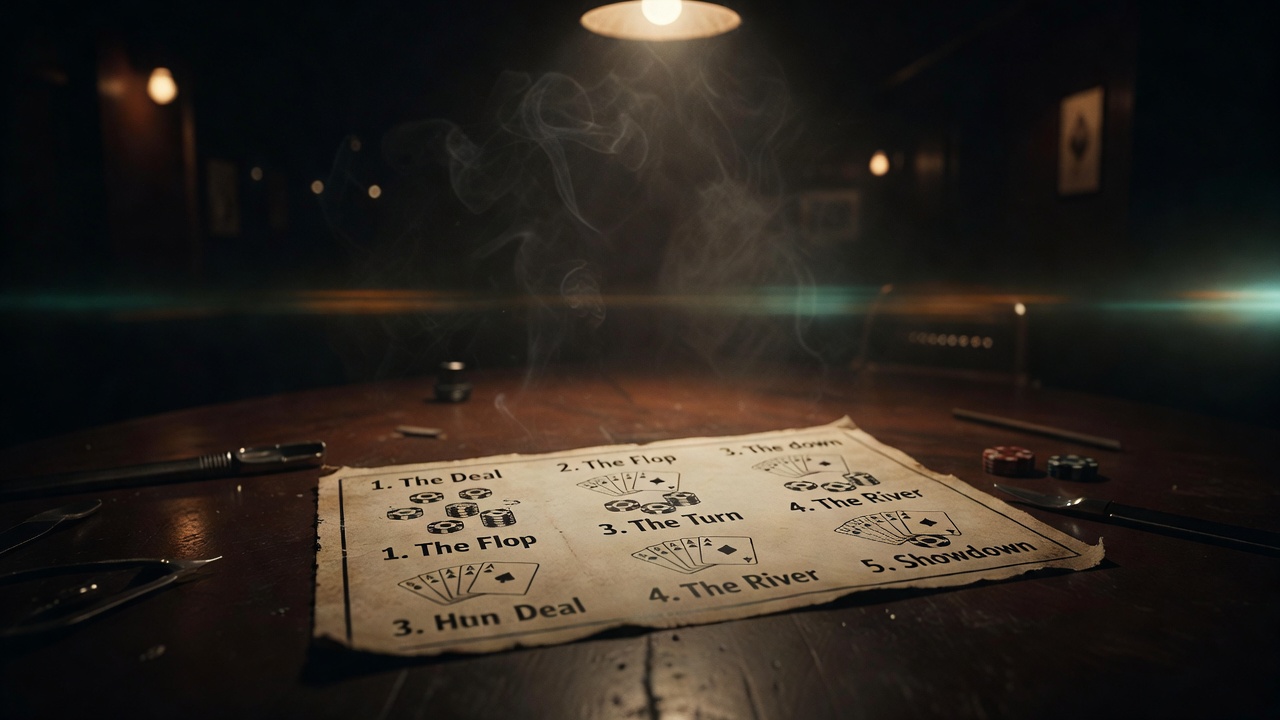
Each hand starts with two players posting mandatory bets called the small blind and the big blind. These establish a pot that players will compete for. Every other player gets two cards face down. These are your hole cards. You see them. No one else does.
Key Elements
There is a round of betting. The player to the left of the big blind acts first. They can fold, call the big blind, or raise the big blind. Action moves clockwise. If anyone raises, everyone else has to call the new bet or fold or re-raise. When everyone has either folded or called the highest bet, the betting round is over.
Now comes the flop: three community cards are dealt face up. Anyone can use these cards as part of their hand. Another round of betting. This time, the small blind acts first. They can check (pass their turn without betting) or bet. If someone bets, everyone else has to fold or call or raise.
Then the turn: a fourth community card. Another round of betting.
Then the river: a fifth community card. Final round of betting.
Now the showdown. Players who are still in the pot have to show their cards. The player with the best five-card hand wins the pot. If everyone but one player has folded, that player wins the pot without showing their cards.
The hand rankings are: royal flush (A-K-Q-J-10 all the same suit). Straight flush (any five cards in sequence all the same suit). Four of a kind. Full house (three of a kind plus a pair). Flush (five cards of the same suit). Straight (five cards in sequence). Three of a kind. Two pair. One pair. High card.
The psychological element is hidden information. You see two cards. You see five community cards. You do not know what anyone else has. But you can make guesses based on their betting. If someone bet aggressively on the flop and checked on the turn, maybe they missed a draw. If someone called everything and then folded when the river came, maybe they were chasing a draw.
Basic strategy for beginners: play tight early. Only play hands you are confident about. Position matters; being last to act is better than acting first. Do not get emotionally attached to your hand. A pretty hand like a pair of sixes might be the worst hand at the table.
The game has been around in its modern form since the 1900s. It became famous when the World Series of Poker started broadcasting it in 2003. It is now the most popular poker variant by a massive margin. Online and live, Texas Hold'em accounts for probably 80 percent of poker played.
The appeal is that it is simple to learn and difficult to master. A beginner can play. A professional can spend their entire career studying the game. The incomplete information makes it interesting. You have to think about probabilities. You have to think about what your opponents might have. You have to make decisions based on expected value, not certain outcomes.
If you want to learn to play, join a friendly game with people who will teach you. Do not start at a casino. Start with friends. Play for small stakes. Learn the rhythm of the game. Learn that folding is not failure; it is discipline.