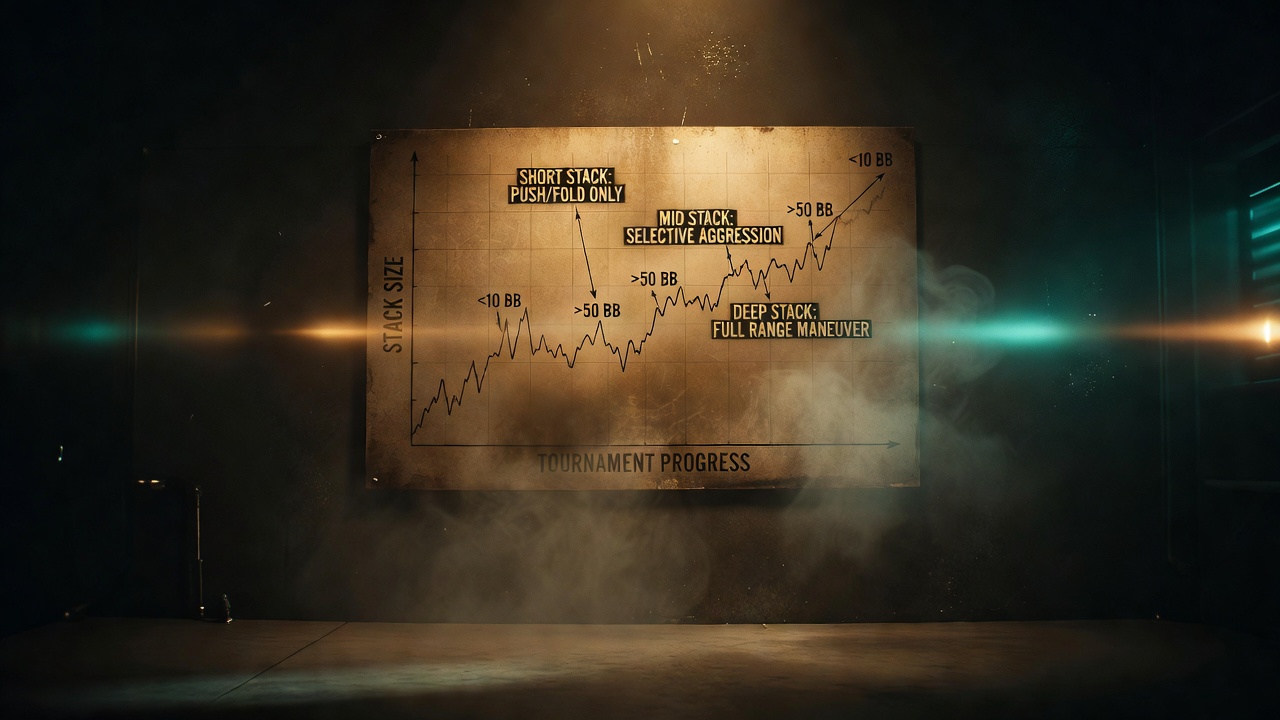
You are three tables from the money in a poker tournament. Your chip stack is very small, maybe eight big blinds. Everybody at your table is playing carefully because they do not want to bust. You have to be dangerous.
A short stack in a poker tournament is different from a short stack in cash game. In cash, you can reload. In a tournament, a short stack means you are on a clock. Every hand that passes is a blind you are losing. Every hand is an opportunity that gets worse every rotation.
Core Principles of Short-Stack Play
The first principle of short-stack play is: stop waiting for premium hands. If you are waiting for a pair of aces, you will probably never play a hand. Your blinds will take your chips before you get there. Short-stack strategy is about winning before you get blinded away.
The second principle is: go all-in with reasonable hands. A pair of sixes from the button is an all-in. A suited ace from late position is an all-in. An upfront limper with pocket eights is an all-in. You are not trying to win a big pot. You are trying to win the blinds immediately.
Third principle: you are going to get called by stronger hands. You know this. Accept it. You are going all-in with less than stellar holdings. The person who calls you probably has a better hand. But if they fold, you win immediately. And if they call, you have cards that can win. You are not a huge dog, and you get paid off if you hit.
Fourth principle: position matters more than usual. The big blind is your worst position. The cutoff is your best position. You are stealing blinds from the button and cutoff with hands you would never play in cash game.
Fifth principle: watch what the big stacks are doing. If they are aggressive and stealing blinds, you want to move into a pot when they are not involved. If they are tight and waiting for premium hands, you can be more aggressive without running into a monster.
I watched a player at the 2016 WSOP with a short stack make seven all-in moves in five minutes. He won four blinds, lost two hands and doubled once. He went from dead to alive. This is the energy of short-stack play.
The mistake that short stacks make is getting cute. You do not have time to trap anyone. You do not have time to set up a bluff. You have time to jam, get called or not, and see if you win. It is simple and straightforward and successful when executed with discipline.
The deeper analysis of this topic reveals that players often overlook the foundational principles. When you understand the mechanics and the motivations behind the game design, you begin to see patterns that were previously invisible. This is where real advantage comes from, not from luck or superstition, but from careful observation and mathematical reasoning applied over time. Every decision matters. Every detail counts. The players who take the time to understand these nuances are the ones who make better choices at critical moments.