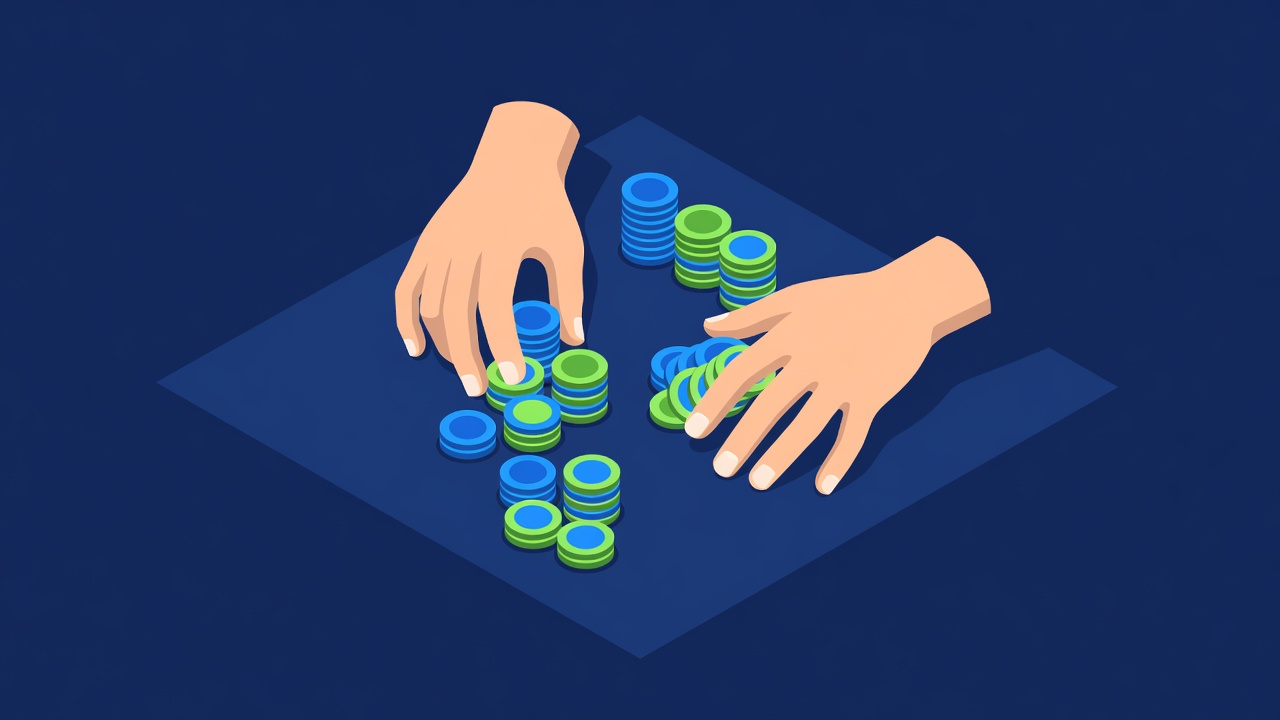
Professional poker players handle chips with specific discipline. They stack them neatly. They move them deliberately. They never splash chips into the middle of the pot. They never make aggressive gestures with their chips. They play an emotionless game with their hands as much as their decisions.
The details of execution separate success from failure.
Casual players handle chips like they are playing with toys. They toss chips. They stack them high and watch them fall. They splash the pot when they bet. They make big gestures. These are tells. They are signals about confidence and emotion and whether the player is experienced.
A professional player keeps their stacks organized. Tens stacked neatly. Fives stacked neatly. Singles separated. At a glance, they know how much they have. At a glance, everyone else knows how much they have. There are no surprises about the chip count.
When a professional bets, they move the exact chips they need. No more. No less. If they want to bet 100, they grab a hundred and place it. They do not splash five twenty-dollar chips and let someone else count it. The specificity is information. It tells you the professional knows exactly what they are betting and why.
When a professional raises, they communicate the amount clearly. They say it out loud. They move the chips deliberately. They do not make big aggressive gestures. They do not threaten with chips or toss them hard. They simply state the raise and move the chips.
The casual player splashes chips into the pot. Multiple chips, some stacks falling, some bouncing. The dealer has to clean it up. The action has to be re-announced. The splash creates confusion. It creates the impression that the player is nervous or inexperienced or trying to hide something.
A professional player never splashes. A professional player places chips clearly and states the action clearly. The dealer sees it, understands it, communicates it to the other players. The action moves on.
Casino surveillance systems watch chip handling. Not because they are looking to catch cheating through chip handling, though that is possible. They are looking to understand player behavior. A player who handles chips carelessly is more likely to make mistakes. A player who handles chips deliberately is more likely to be experienced.
If you play live poker and you want to seem like you know what you are doing, learn chip handling. Keep your stacks organized. Bet deliberately. Do not splash. These things cost nothing and convey competence. They also save you from telling the table that you are a recreational player who is going to lose money.
The best chip handling I have ever seen was at professional high-stakes games where the stacks were so organized and the bets so deliberate that it looked like machinery, not people.
The deeper analysis of this topic reveals that players often overlook the foundational principles. When you understand the mechanics and the motivations behind the game design, you begin to see patterns that were previously invisible. This is where real advantage comes from, not from luck or superstition, but from careful observation and mathematical reasoning applied over time. Every decision matters. Every detail counts. The players who take the time to understand these nuances are the ones who make better choices at critical moments.