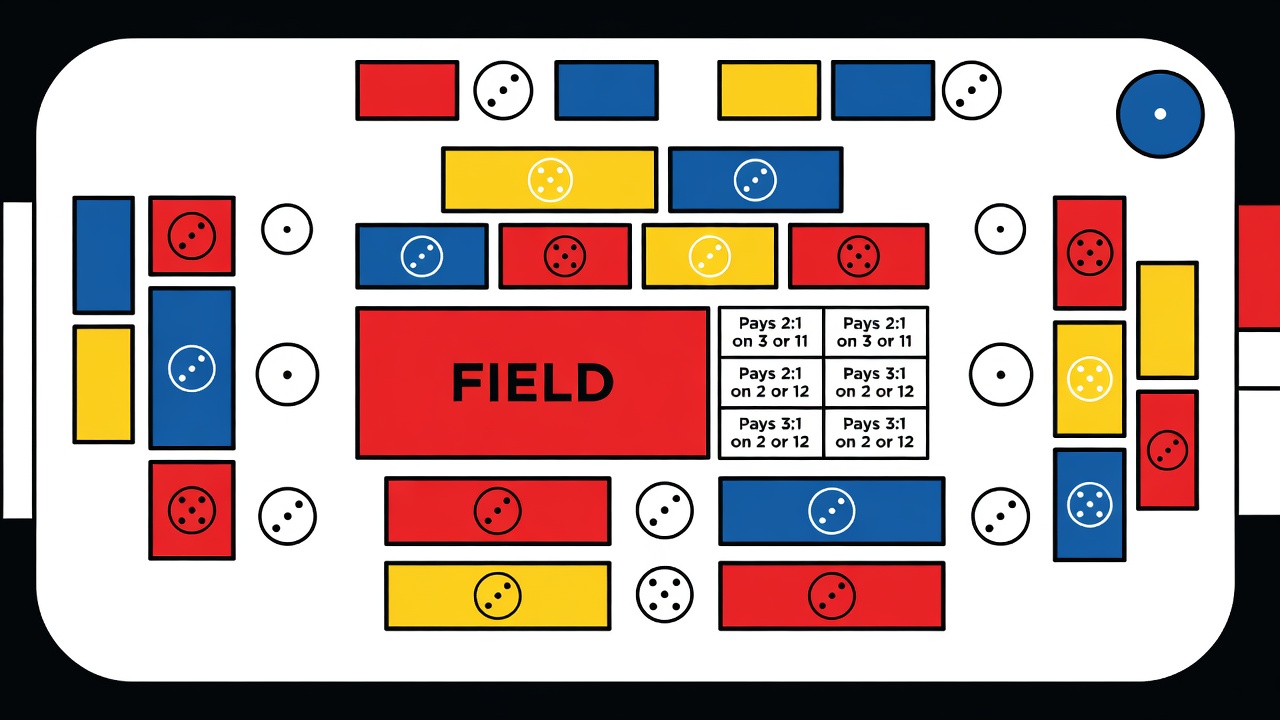
Craps is a game of named bets and unfamiliar odds. The field bet sits at the bottom edge of the table layout, offering to cover eight numbers: 2, 3, 4, 9, 10, 11, 12. The field pays even money on 3, 4, 9, 10, 11. The field pays double on 2 and triple on 12. If you bet the field, you win if any of those eight numbers comes up on the next roll. You lose if any other number comes up.
The mathematical proposition is straightforward. Twenty outcomes exist on a craps table (all possible two-dice combinations from 2 to 12, excluding 7, because 7 ends the round). The field covers eight of those outcomes. The payouts average approximately 1 to 1 across the eight winning numbers, weighted by frequency. The house edge on the field bet is approximately 5.56 percent, which makes it one of the worse bets on the craps table.
The don't pass line, by comparison, has a house edge of approximately 1.4 percent. The pass line, which most new players bet, has a house edge of 1.41 percent. The field bet is almost four times worse than the fundamental bets at craps. By the basic mathematics of expected value, if you are going to play craps, you should avoid the field entirely.
Yet people play the field. Why? Several reasons. First, the field is simple. You understand the payout immediately. You watch the dice roll, you see whether your numbers come up, and you know instantly whether you have won. There is no geometry of odds or conditional logic. This simplicity has appeal, particularly to players who are new to craps.
Second, the field is interactive. Craps is a social game where multiple players make different bets. The field player is visibly different from the pass line player. There is something about being the guy betting the field that feels like an alternative strategy, even if it is not.
Third, the field generates action. Because the payout on 2 and 12 is higher than standard, individual field bets occasionally return significant payouts. A twenty-dollar field bet on a roll that produces a 12 returns one hundred twenty dollars. This infrequent but explosive upside creates what behavioral economists call the availability heuristic. Players remember the one time they hit a field triple more than they remember the dozens of times they missed.
The only circumstance under which the field bet becomes mathematically reasonable is when the casino offers a promotional payout that increases the standard returns. Some casinos will temporarily pay double on 12 and double on 2, which shifts the house edge significantly. These promotions are rare and temporary, but they exist, and when they do, the field becomes marginally acceptable as a short-term bet.
For standard play, the answer is clear. The field is an inferior bet. If you wish to play craps, avoid it. Bet pass or don't pass. Lay or take odds behind the line. These bets have edges under 1.5 percent. The field, by contrast, is a slow erosion of your bankroll in exchange for the feeling that something might happen. Sometimes, at a craps table late at night, the feeling that something might happen is worth four percent. Most of the time, it is not.
Key Considerations
The fundamental principle behind this topic involves understanding several interconnected factors. Each plays a distinct role in the overall picture. First, you must grasp the mechanism. Second, you need to recognize how it applies to your specific situation. Third, you should understand the exceptions and edge cases.
- The first consideration involves mechanics: how the system actually works
- The second involves application: how to apply knowledge to your situation
- The third involves exceptions: when normal rules do not apply
Different perspectives exist on this topic. Some emphasize one aspect more than others. The most complete understanding comes from considering multiple viewpoints and recognizing what each reveals about the underlying truth.
The practical wisdom here is that understanding requires both mechanics and experience. You can read about something theoretically, but real understanding comes from engagement with it.
Therefore, when you encounter this topic in practice, remember to think systematically about what is happening and why. The details matter. The structure matters. The exceptions matter. Approach it with the rigor it deserves.